Sunday, March 21, 2010

More on the PIIGS Debt Coming Due

Yesterday I wondered about whether all of this PIIGS debt panic was warranted. I don't contest that there is debt problems that need to be fixed (and not just in Southern Europe), but I also don't think that there's any reason to be alarmed over the debt coming due in the next couple of months. If you would, however, want to be alarmed by the debt coming due in 2012, I'd completely understand. The reason I'm not alarmed is because those euros have to go *somewhere* once these bonds start coming due and while there may be some movement away from Greece, it's not like liquidity is going to suddenly dry up for sovereign issues and Euro area countries are going to be stuck, unable to refinance their debt. Yeah, they might have to refinance it at higher yields, but they will refinance it. Considering how low interest rates are right now, I wouldn't be surprised if the debt they are retiring is going to be refinanced at lower rates, reducing the debt service expense. I'm working on this last point right now, but it's very labor intensive.

Regardless of how many bad things you hear about these countries in the media, it's still sovereign debt, not corporate junk. It's not low-rated, you can repo it at the ECB and, most importantly, the other European banks are buying it. And you know what? As long as they can be repod for liquidity, the banks will keep buying these bonds and strolling carefree down the meadows of borrow short, lend long. Yields may or may not accurately reflect default risk, I do not know, but barring a huge, sudden jump in interest rates, this is just not that big of a deal. And since I don't see inflation in our near future, I'm not too concerned about that.

In the mean time, a weaker Euro will probably help support tourism and give a boost to manufacturing, buying everyone a little more time.

Saturday, March 20, 2010

PIIGS Debt Coming Due: Is it really an issue?

Der Spiegel published the following graph as part as the ongoing Portugal / Greece / Italy / Ireland / Spain crisis porn.


Let's not all just freak out just yet. Let's do our homework:

As of this writing the PIIGS are borrowing ta the following rates (Economist 3/20 -3/26):
  • Portugal: ??
  • Ireland: ??
  • Italy: 3m @ 64bp and 10y @ 390bp
  • Greece: 3m @64bp and 10y @594bp
  • Spain: 3m @ 66bp and 10y @ 384bp
The economist also tells us that the average maturity of this debt stands as follows

  • Portugal: 6.5 years
  • Ireland: 6.8 years
  • Italy: 7.2 years
  • Greece: 7.7 years
  • Spain: 6.7 years
Now, what I'd like to know is when this debt coming due was issued and at what cost to the government. If the yield at issue was higher than their current borrowing rates, well, that's not really a problem. Second, who owns all this debt? The local banks? foreign banks? regular people? If it's mostly local banks that hold this debt, i don't imagine the refinancing is going to be much of an issue, after all, the banks have to do something with that cash. Could rates move up as the supply of debt overwhelms the demand? Yes. Do I think this is as big of a deal as it is being painted to be? Hell no.

Tuesday, March 16, 2010

A note about securitized loans

CLOs pool loans and slice them into securities of varying risk intended to provide higher returns than similarly-rated investments.
-- via Bloomberg CLOs to End 12-Month Drought in Citigroup Deal


Uhm. This is what is wrong with everyone. Have these people never heard of conservation of probability? Slicing and dicing loans doesn't improve the quality of the underlying, it just redistributes risk across tranches and security holders to reduce the variance. Without so much as touching on David Merkel's great point about lower quality in originate-to-securitize loans, the overhead needed to securitize these loans effectively reduces the aggregate return on the whole pool as well as lower the probability adjusted return of the pool.

Saturday, March 13, 2010

A Closer Look at Retail Sales

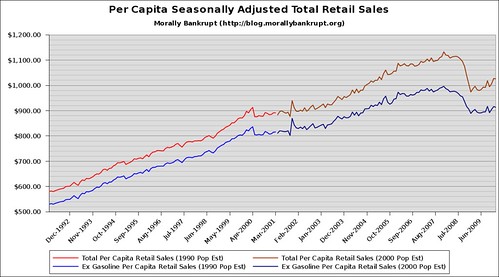
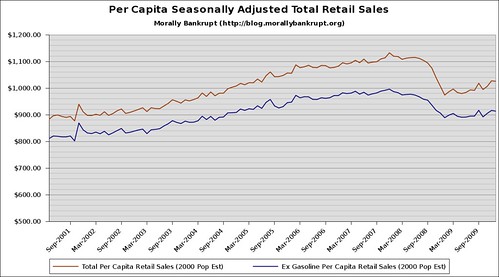
Well, we got new retail sales numbers from the Census Bureau. Calculated Risk reported an increase but, just like last month, these numbers are a little less bright when adjusted for population changes. Please take in mind this is a census year, and we'll have a new population estimate soon, but if the gap between the 1990 and 2000 estimates is any indication, the difference shouldn't that large. While we continue to see minor weakness in the population-adjusted sales, it's starting to look like we are just moving sideways, which is not good news, but it's better than bad news.


One of the items that I find discouraging is the percentage of sales volume that is gasoline sales. While sales numbers are moving roughly sideways, the amount of money spent on gasoline has been increasing. The increasing sales volume of an item with a low short-run elasticity of demand just means people's income are increasingly tied up in covering the necessities and their disposable incomes are shrinking. That is not good news for the consumer. Where are all those gasoline savings Cash4Clunkers was supposed to bring us?


I also added a chart including per-employee retail sales, which show us some tremendous improvement in the retail sector. It looks like retail was able to adjust employee-levels quickly and the per-employee sales number is actually very close to the peak levels.

Chinese Money Supply: Record Low Reserves (17%)

To see the latest data please see the label Chinese Money Supply
Note that the numbers available from the PBC only go from Jan2004-Dec 2009. As soon as the 2010 numbers are available I'll post an update. Also, if you are perplexed by that spike in reserves, there is a very simple explanation: Chinese New Year.

Traditionally, Red envelopes or red packets ... are passed out during the Chinese New Year's celebrations, from married couples or the elderly to unmarried juniors ... Red packets almost always contain money, usually varying from a couple of dollars to several hundred.

Wikipedia: Chinese New Year

Feb 2010 Unemployment

We have unemployment, yes we do! We have unemployment, how ‘bout you?!
How’s a young man gonna meet his financial responsibilities workin’ at a motherfuckin’ Burger King? He ain’t!

Friday, March 12, 2010

This is not Progress: Transaction Taxes

There have been many calls for a transaction tax. I oppose all of them. I am not a free-market fundamentalist, but intervention here will help nobody. I understand the desire to tax speculator's trading activities, they can often be seen as value extracting instead of value creating activities, but at the end of the day, they do add liquidity and lead to tighter spreads, even if the liquidity is of low quality. The problem here is regulatory arbitrage, the transaction tax can easily be circumvented by moving transactions off-shore. I understand that is not trivial, but all the large  operations, the ones that can really affect the financial system, are big enough to be able to move the taxable operations because the cost of moving the operation will be less than the cost of paying the tax. Meanwhile, all the smaller players will be stuck paying the tax.

There is a lot of legitimate transactions that would end up burdened by the tax, from a small airline hedging fuel costs to a farming operation locking-in a price on a harvest, to a municipal water company hedging their energy costs (you'd be surprised at how much electricity those pumps need). The media has called it a "Robin Hood" tax and the politicians are throwing numbers like "0.25 percent" around. They just don't get it. First of all, this would mean bye-bye to the money market mutual fund industry and it's associated returns for holders of cash. Secondly, it would wreak havoc in the Fx markets and inevitably lead small money-changers to go into the black market since the tax would be bigger than the current bid-ask spreads. Finally, the tax would just end up being paid by consumers in the form of higher prices. I won't even touch the subject of market makers, whether official or de facto.
We need to fix problems, not symptoms! This is not progress.

1.) http://www.guardian.co.uk/business/2010/feb/09/tobin-tax-nighy-curtis-film
2.) http://www.bloomberg.com/apps/news?pid=20601103&sid=anYlPWIEm6gE
3.) http://www.lexology.com/library/detail.aspx?g=de4f41cb-2d89-410b-88ed-696853e482ec

Saturday, February 13, 2010

Per-Capita Adjusted Retail Sales: Not Such a Bright Picture

1992-Present Seasonally Adjusted Per Capita Retail Sales

2000-Present Seasonally Adjusted Per Capita Retail Sales
Earlier today Calculated Risk posted about an improvement in total retail sales. I was interested in how these numbers would look once adjusted to their per-capita numbers. Obviously the population estimates (from the Census Bureau) might have a little bit of an error margin, but I wanted to see how the spending trends of Americans had, or had not, changed. In essence, I wanted to know if people were really spending more, or if the growth in total sales was just a by-product of population growth.

This doesn't say much about the retail sector, because it isn't adjusted to account for store openings and closings, in other words, as stores close and sales keep steady, revenue per store is increasing, but it does give us some clues as to whether there is upcoming expansion in the retail sector as the recovery takes hold. From what I gather from these graphs, I'd say an expansion in the number retail outlets is not something we should be expecting any time soon, which is bad news for REITs that operate shopping centers.

There is no adjustments for price levels, because of auto-correlation. Please feel free to submit questions, comments, or sector-specific requests.

I look forward to, in the future, making all my data sources available so they can be reviewed by anyone who may have any doubts about my methods. Just hold on a bit for that.

Sunday, January 31, 2010

This is not progress: Move Your Politician’s Money?

 From The Baseline Scenario:

what happens when the location of political candidates'own money starts to matter. As early as this fall's primaries, expect to hear people ask politicians in debates and through various kinds of interactions: (1) where do you, personally, keep and borrow money, and (2), in all relevant cases, where did you put public money when it was up to you?

Make them put the money where their mouth is? Seems plausible for demand deposits, notes and revolvers; however, who you gonna call when you need to place $3B of callable notes in the muni mkt? Hopefully not your friendly neighborhood credit union. Investment Banking: somebody gotta do it.

Don't government agencies have to use the service provider of least-cost that meets all of the stated deliverables? What happens when Mayor Joe Corrupto decides to do all the town banking through the local Bank that his biggest campaign donor is heading?

Don't get me wrong, I think the idea makes a tiny bit of sense. But only if local banks can provide the same or better service for equal or lesser cost than TBTF banks. Any other way is just begging for favoritism and corruption.

Thursday, January 14, 2010

Chinese Money Supply


When China announced on January 12, 2010 that they were going to raise reserve requirements by 50 basis points everyone broke out in a panic about it. People speculated there would be crashes, that that there was a crazy China bubble or that the Chinese banks were driving asset-price bubbles through insane leverage. While the Chines Money Supply has indeed been growing faster than before as of late, that makes sense. Last year assets were depressed, leaving room for upside, and credit was hard to get. The Chinese central bank dropped reserve requirements by 50 basis points, which encouraged lending. As things settled down people resumed lending and borrowing. Nothing really crazy is going on. If you are part of the Minsky club, like I am, you consider a significant credit boom an essential part of a bubble. So, let's see if there really is some crazy Chinese bubble or if the Central Bank was just returning things to normal.
Please also note how high their reserves are. American banks keep only 10% of reserves on their transaction deposits (checking accounts). Savings accounts, and CDs are time deposits and have no mandated reserve requirement. Do your homework people. It's not that hard.
Sources:
People's Bank of China
Reserve Requirements (NY Fed)