Showing posts with label PIIGS. Show all posts

Thursday, November 3, 2011

Things EFSF Will Not Fix

Expecting a bunch of bureaucrats to fix a decade's worth of accumulated imbalances in a matter of months with some alphabet soup ain't gonna work. What will work? Peripheral countries deflating with respect to core. Not only will it work, but it is the only thing that will work. Pictures follow. Toodles!
Cumulative Inflation relative to Germany. (i.e. Germany CPI would be a flat line at zero)

Balance of Trade (Exports-Imports) for GIIPS

GIIPS Balance of Trade as a % of GDP


Balance of Trade for selected European economies

Balance of Trade for selected European economies as a % of GDP


Tuesday, March 22, 2011

ESM / EFSF: An Inverted Capital Structure

I've been meaning to write about this for quite some time, but it's been really hard to have the time to sit down and do it. I've let perfect be the enemy of good and so here I'll try to lay out a rough sketch of what I think are some of the possible risks of the EFSF / ESM.

From Reuters:
The euro zone's permanent bailout fund, the European Stability Mechanism ... which will have an effective lending capacity of 500 billion euros, will be backed by 80 billion euros of paid-in capital and 620 billion euros of callable capital ... It will offer loans at funding costs plus 200 basis points for loans up to three years and plus another 100 basis points for loans longer than three years.
What you are seeing here is what Michael Pettis described as an "inverted" capital structure in his excellent book, The Volatility Machine. What that means is that there is positive correlation between the need for funds, the cost of funds and the credit quality of the facility. This is problematic because it could cause reflexive price action in the bonds of the aid recipients, lowering the value of the EFSF holdings and furthermore deteriorating its perceived credit quality. This is also sometimes referred to as "wrong-way risk" when talking about CCPs. In other words, "the risk that different risk factors be correlated in the most harmful direction." AKA a vicious cycle.

Here's some numbers from the June 7, 2010 EFSF execution agreement. They represent the subscription amount and percentage to the EFSF.  The EFSF is just a legal entity where various countries contribute capital and become equity holders (with unlimited liability). The contributed capital and proceeds from bond issuance are used to make loans to countries that need aid. The bonds are guaranteed by the full faith and credit of the EFSF, the EFSF equity holders (EUM member states), the EU, and have the EFSF holdings as collateral. The table below is a breakdown of the contributed capital so far. Issued debt is to be overcollateralized at a rate of no less than 120% by AAA Holdings and AAA guarantees. There is also to be a cash reserve that equals the NPV of the margin of the EFSF loan and service fee. The EFSF is available to all EMU member states.

ECB Member State Capital subscription Contribution Key %
Kingdom of Belgium 2.4256 3,475494866853410%
Federal Republic of Germany 18.9373 27,134106588911300%
Ireland 1.1107 1,591454546757130%
Kingdom of Spain 8.3040 11,898297070560200%
French Republic 14.2212 20,376693436879900%
Italian Republic 12.4966 17,905618879089900%
Republic of Cyprus 0.1369 0,196155692312101%
Grand Duchy of Luxembourg 0.1747 0,250317015682425%
Republic of Malta 0.0632 0,090555440132394%
Kingdom of the Netherlands 3.9882 5,714449467342010%
Republic of Austria 1.9417 2,782143957358700%
Portuguese Republic 1.7504 2,508041810249100%
Republic of Slovenia 0.3288 0,471117542967267%
Slovak Republic 0.6934 0,993530730819656%
Republic of Finland 1.2539 1,796637126297610%
Hellenic Republic 1.9649 2,815385827787050%
Total 67.8266 100,000000000000000% 

Where is the risk? Well, the risk here is that everyone is guaranteeing everyone. So, if Ireland Portugal and Greece need aid, their guarantee is pretty much worthless, and they are now users of the fund. If another state were to need aid, another piece of the guarantee would become worthless and need for funds would increase. This would increase the cost of funds, which would be passed on to aid receivers. Unless the states receiving aid are running a budget surplus, this would translate to increasing borrowing needs to cover additional debt service costs, furthermore deteriorating their quality.

Of course, losing Portugal's guarantee is unlikely to be disastrous, but if Belgium and Spain were to find themselves in trouble too, that would put additional pressure on the remaining members, affecting their own credit quality. While it might be no more than an inconvenience to Germany or France, it could adversely affect smaller economies. It could, in essence, leave France Germany and Italy holding the collective bag. I have no clue as to the probability of this happening, but the risk is present and shouldn't just be ignored. If we were to think of bonds as way deep out-of-the-money options (this model goes beyond of the scope of this post), you would notice that you are basically short a lot of gamma here. As the situation deteriorates, the speed at which it deteriorates increases. Of course there is the possibility that it will all work out, which is what the EU is banking on.

I'm not going to get into the gritty part of of this until I have more time, but I think the best way to think about it is as a highly-levered, short way-out-of-the-money put on the EU sovereigns. The probability of going into moneyness might be remote, but the damage in that case would be catastrophic. Buy the paper at your own risk.

Thursday, May 6, 2010

Is the Elite Liberal Media instigating panic? (UPDATE-2)

The title is just a joke, although the NYT isn't exactly my go-to when it comes to financial reporting. Anyway, Barry Ritholtz ran the following chart from the NYT today.


Which is cool and all, but by my calculations the debt looks quite different. Granted, this data is like 5 weeks old, but the gaps are so large in some cases that something must be wrong because there hasn't been that much activity in sovereign issues/redemptions. I'll pull up the data on Bloomberg some other time and give you an update, but at first glance, there is something deeply wrong with this graph. Either this is not sovereign debt or someone made a mistake. Maybe they are counting bank debt too? I don't know, but comment if you do. Take in mind NYT is reporting the debt in dollars. Considering EURUSD = 1.27 at time of writing, I think someone fucked up.


By my calculations:
  • Ireland is closer to EUR 200MMM or US$254MMM
  • Italy is more like EUR 1,050MMM or US$1,335MMM
  • Spain is EUR 339MMM or US$430MMM
  • Portugal is EUR 97.5MMM or US$123MMM
  • Greece EUR 260MMM or US$330MMM
UPDATE-1: I got a reply back from Bill Marsh at the NYT. His reply was so prompt and complete, that I feel bad I even make the joke about them. They really are an exemplary organization. They embrace digital media, new content delivery and monetization and are huge supporters of Open Source Software and open data initiatives. Apologies out of the way, here's what he said
the figures come from this report and are for the end of 2009. the data starts on page 74 and covers all countries (note that the numbers for each european country’s debt-holders are spread across pages 74, 78 and 82).

http://www.bis.org/statistics/provbstats.pdf#page=74

these figures include both government and bank debt. hope that helps!
Mystery solved! The data comes from the Bank for International Settlements. Unfortunately, this isn't such good news, and here is why:
  • OK, I lied, there is one piece of good news, the weakening Euro reduces the dollar value of these liabilities, so, in that respect, they are overstated.
  • There has definitely been increased borrowing in the part of sovereigns since December 2009, particularly the ones in question which have significant budget deficits. Even the data I posted understates this, since there has been debt placements since then.
  • The numbers appear to exclude internal debt, which means total liabilities are actually understated
  • With widening spreads and downward rating revisions, banks might have to tighten lending to offset changes capital that is marked-to-market. Although, no big deal since all this stuff can be repoed at the ECB.
  • The Euro zone could see capital flight, which would widen spreads and put stress on the banks as assets move, forcing them to either finance their assets with debt or liquidate some of them, putting additional downward pressure on the assets
  • That Ireland number is SCARY. Not a lot of it is sovereign debt, a lot of it is bank debt, but that's too-big-to-save territory for the Irish government. If they face another banking crisis, they're going to need to go outside for help. It's $206,429 of debt per-capita!
Compare with: (credit: Marc P @ Big Picture)
    • Ireland  $206,429
    • Portugal  $26,729
    • Spain  $27,160
    • Italy  $24,096
    • Greece  $22,056
    • USA $38,737 
    By the way, this is why I hate it when they convert figures to dollars from their original currency. Liabilities and assets should be listed in the currency they are denominated in. Exchange rates are only valid for a very brief point in time, making the data kind of useless or hard to use once that piece of information changes.

    UPDATE-2: It has been brought to my attention that the Ireland figure is probably vastly inflated by the debt from financial organizations with operations in the IFSC. My apologies for this glaring omission. (MB - 05/17/2010)

      Thursday, April 22, 2010

      All debts must be paid, even Greek ones

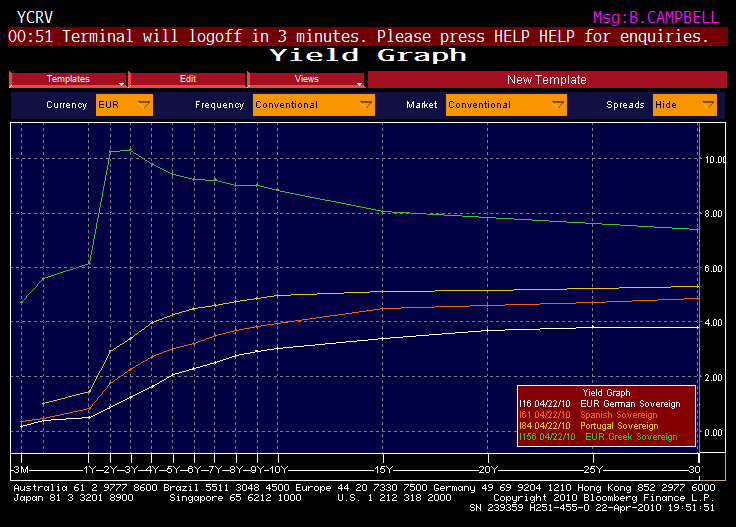
      So, I'd like to publicly admit here that I was oh-so-wrong about Greece. It looks like they really won't be able to make it through May without a bailout. I really didn't expect this to happen until 2011 or 2012 but, with 10yr rates at over 800bp, fresh downgrades and rumors of restructuring, it doesn't look so good. While many are going to go on about the moral hazard in the bailout and why they should be kicked out of the Euro, I want to focus on something else.

      Why would other Euro countries agree to a bailout?
      Let's start with what I think is the biggest part, which I will explain with the this quote,
      "When you owe someone $1,000 and you can't pay, you have a problem. When you owe someone $100,000,000 and you can't pay, they have a problem."
      Banks across Europe hold Greek bonds. The fact that they could be repoed at the ECB for liquidity and they had a higher yield made them attractive. If Greek creditors push Greece too hard, they might just take their proverbial ball and go home. They really could just give up on the Euro and tell their creditors: I'm not paying you. If that happens, a lot of European banks are likely to face substantial losses. I can't tell you how much because there is no reliable source for this data, even what you see in Die Spiegel seems a little iffy. If what we saw during the Panic of '08 is any indication, banks taking the Greek losses would simply end up bailed out by their respective governments anyways. The liabilities won't vanish, they'll just move to a larger balance sheet until they reach the biggest one (governments), at which point they are socialized. It's just the way it works at this present point in time, so deal with it.

      Back to defaults: A ruthless external default would do no good for anyone. A disorderly financial meltdown would risk contagion across the rest of the heavily indebted EU nations and emerging markets. Rising spreads could put enough pressure on the likes of Spain, Italy or Portugal that they too decide they can't/don't want to play the EUR game anymore, which brings us back to the whole bank liabilities thing. Someone, somewhere owns all this debt and someone, somewhere is going to have to take a loss if we let this all get out of hand and, if that loss is big enough, then we'll all have to share this loss through inflation, recession, higher taxes, service cuts etc. There is no way around it, the debt must be paid in some form or another by someone. Stoking a disorderly collapse will just ensure we'll be the only ones cleaning up the ensuing mess.

      I love recession pr0n just as much as the next blogger (we are a bearish bunch) but these are real lives we are talking about. I am in no means fan of a bailout, but it might be the least-costly way to resolve this. Italy, Ireland, Spain and the UK are all on shaky ground as far as debts go, they don't need their spreads shooting up. A disorderly collapse that leads to bank bailouts, another recessionary dip and more fiscal stimulus sounds really expensive,  politically, socially and financially. Greece might be able to get out of this predicament, or not, but we won't know unless they get a chance. Yes, the proposed rescue package is essentially just kicking the can down the road, but time has a funny way of healing some wounds.

      I can't believe you are defending that profligate bunch! Why couldn't be more like industrious Germany with that awesome trade surplus?!
      Whatever, seriously. You can't run a surplus without someone running a deficit, it's just the way it works. Savers need borrowers and vice-versa. Not only that, but Greece paid a risk-premium. A risk-premium is extra yield you pay because there is--wait for it--risk! A risk-premium is what you pay for the right to fail. By asking for a risk premium the market is saying, "We'll lend you this money, but at higher rates because we are not sure you'll be able to pay us back." Creditors can demand their money all they want, but you can't take back something that isn't there anymore. They aren't going to get it, so they might as well try to be civil and try to figure out a plan to recoup whatever they can because at this point the debtor holds a lot of cards.

      To end, here's some graphs for your viewing pleasure (GREECE SHORT is short T-bills, the rest is bonds):

      Monday, March 22, 2010

      A Final Note Regarding PIIGS Debt

      I want to issue a clarification on the statements I made yesterday and Saturday. I am in no way saying these bonds are good purchases or that the fiscal situations in these countries are OK. Austerity measures will probably hurt recoveries, people who's benefits are cut are going to be pissed, and politicians are going to have to do some very unpopular things. A good place to look for inspiration, as The Economist noted, is Eastern Europe. My point was that the problems these nations are facing, particularly Greece, are deep problems that have been long ignored. Greece's issue is not that it's facing unfavorable refinancing rates, it's that it needs to finance debt service, something that David Merkel very eloquently covered with his post You Can't Cheat an Honest Man.

      With that said, I'll leave you with a little excerpt from Hyman Minsky's wikipedia page:

      For the "speculative borrower", the cash flow from investments can service the debt, i.e., cover the interest due, but the borrower must regularly roll over, or re-borrow, the principal. The "Ponzi borrower" borrows based on the belief that the appreciation of the value of the asset will be sufficient to refinance the debt but could not make sufficient payments on interest or principal with the cash flow from investments

      Sunday, March 21, 2010

      More on the PIIGS Debt Coming Due

      Yesterday I wondered about whether all of this PIIGS debt panic was warranted. I don't contest that there is debt problems that need to be fixed (and not just in Southern Europe), but I also don't think that there's any reason to be alarmed over the debt coming due in the next couple of months. If you would, however, want to be alarmed by the debt coming due in 2012, I'd completely understand. The reason I'm not alarmed is because those euros have to go *somewhere* once these bonds start coming due and while there may be some movement away from Greece, it's not like liquidity is going to suddenly dry up for sovereign issues and Euro area countries are going to be stuck, unable to refinance their debt. Yeah, they might have to refinance it at higher yields, but they will refinance it. Considering how low interest rates are right now, I wouldn't be surprised if the debt they are retiring is going to be refinanced at lower rates, reducing the debt service expense. I'm working on this last point right now, but it's very labor intensive.

      Regardless of how many bad things you hear about these countries in the media, it's still sovereign debt, not corporate junk. It's not low-rated, you can repo it at the ECB and, most importantly, the other European banks are buying it. And you know what? As long as they can be repod for liquidity, the banks will keep buying these bonds and strolling carefree down the meadows of borrow short, lend long. Yields may or may not accurately reflect default risk, I do not know, but barring a huge, sudden jump in interest rates, this is just not that big of a deal. And since I don't see inflation in our near future, I'm not too concerned about that.

      In the mean time, a weaker Euro will probably help support tourism and give a boost to manufacturing, buying everyone a little more time.

      Saturday, March 20, 2010

      PIIGS Debt Coming Due: Is it really an issue?

      Der Spiegel published the following graph as part as the ongoing Portugal / Greece / Italy / Ireland / Spain crisis porn.


      Let's not all just freak out just yet. Let's do our homework:

      As of this writing the PIIGS are borrowing ta the following rates (Economist 3/20 -3/26):
      • Portugal: ??
      • Ireland: ??
      • Italy: 3m @ 64bp and 10y @ 390bp
      • Greece: 3m @64bp and 10y @594bp
      • Spain: 3m @ 66bp and 10y @ 384bp
      The economist also tells us that the average maturity of this debt stands as follows

      • Portugal: 6.5 years
      • Ireland: 6.8 years
      • Italy: 7.2 years
      • Greece: 7.7 years
      • Spain: 6.7 years
      Now, what I'd like to know is when this debt coming due was issued and at what cost to the government. If the yield at issue was higher than their current borrowing rates, well, that's not really a problem. Second, who owns all this debt? The local banks? foreign banks? regular people? If it's mostly local banks that hold this debt, i don't imagine the refinancing is going to be much of an issue, after all, the banks have to do something with that cash. Could rates move up as the supply of debt overwhelms the demand? Yes. Do I think this is as big of a deal as it is being painted to be? Hell no.