Showing posts with label debt. Show all posts

Sunday, July 31, 2011

The sewers I swim in

Boston sewer image from Liquid Assets
I've seen lots of arguments about why reducing the deficit right now would bring crisis to the economy. Most of them are very textbook Keynesian arguments arguing that at times of excess capacity, reducing deficit spending would just add headwinds to an already struggling economy. The other argument is that the US should take advantage of exceptionally low borrowing rates to invest in rapidly aging infrastructure and put Americans back to work using a sort of New Deal 2.0 scheme.

The first argument is a bird's eye solution to a ground-level problem. Yes, government spending would goose GDP, but is that spending creating wealth? Where is that "stimulus" going? Our goal, after all, is not to maximize GDP, but to maximize wealth. GDP is just a poor objective measure for a deeply subjective phenomenon and gaming our own framework won't help anyone, regardless of what numbers the BLS, BEA and FRB release over the upcoming months. And let's not forget that Washington has a very poor track record as an allocator of capital. I'm simply not comfortable leaving these decision up to the people that decided to try to reflate the bubble by pulling-forward demand, subsidizing toy arrows and foreign liquor and build useless airports. Just sayin'.

But does this mean we should address the crisis with full-throttle austerity? Not quite. As it was eloquently pointed out last Summer on interfluidity, austerity is stupid and deficits are dangerous. We can't make generalizations about debt, deficits or balanced budgets. Deficits and debt are neither good nor bad on their own. Leveraging up for wealth-creating projects is good, borrowing to throw money away shoveling sand from one pile to the other not so much. Washington is focusing on abstract goals like "putting real Americans to work." And one can't blame them because that's what people want, jobs. But "jobs" isn't something you can simply create from thin air, you can't just throw money at this problem and expect to fix it. "Jobs bills" and "improving America" are nebulous ideas, subject to interpretation without any objective way to measure success or failure, which is probably what Washington wants.

"Well, fine, but what do you suggest then?" you may be asking yourself. I just want to say one word to you. Just one word. Sewage. We've spent the better part of the last 10,000 years trying to secure sources of clean water and get rid of waste. Humanity has developed modern plumbing and sanitary sewers. We survived the Great Stink of 1858. We've battled epidemics of water-borne disease, droughts and floods.  I feel comfortable in making the broad statement that clean water is good and shitty water is bad. Therefore, one could expect that making something good out of something bad would be a positive thing, an improvement, a wealth-creating action. If you disagree, feel free to stop reading now.

All of which brings me back to our original topic, the deficit. We have swaths of unemployed persons and slack capacity in all aspects of construction, record-low financing rates, and an economy that uses fresh potable water faster than it replenishes it (including aquifer sources). Wouldn't it be great if we could put excess capacity to work creating an infrastructure that helps us achieve sustainability and conserve one of our most vital resources while financing it all at record-low rates? Well, we can, and it's called sewage treatment. It's the effective, efficient and inexpensive process of cleaning water.

The Deer Island Treatment Plant on the Boston Harbor provides primary and secondary treatment for the waste and storm water of the greater Boston area. It serves 43 communities, 2.5 million people and hundreds of thousands of businesses and it cost $3.8 billion to build. The entire MWRA had $176M of sewer-related operating expenses in FY2010 (pg 50). That works out to $70.40 per-person per-year. That figure includes not only the plant, but the entire sewer system as well as treatment of storm water and one of the most advanced plants in the country. DITP not only discharges water that is cleaner that the water it is being discharged into, but it efficiently decomposes organic waste using anaerobic digestion, reducing the volume of the sludge by 90% and using the resulting methane gas to help heat/power the plant. The dried, pelleted result of the digestion process is sold as Bay State Fertilizer (the heat naturally created by the digestion and drying process kills the harmful pathogens). So, for $70.40 per-person, per year, the MWRA cleans, on average, 360 million gallons of waste-water per-day and turns the organic water contained in it into energy and high-quality fertilizer, saving the city millions of dollars in sludge transportation and disposal fees, all while keeping the harbor clean. And while the $3.8 billion cost of construction may sound like a lot, consider that the plant had an initial 30-year expected life, meaning buying the plant on credit and amortizing it over 30 years (using the current 30y tsy rate of 4.12% as a proxy) would cost a only $7.36 per-person, per month. To put it all in perspective, including both amortization costs and operating costs, the cost per-thousand gallons of water treatment comes out to $1.48, or about the price of a medium-sized water bottle in a convenience store.

That's deficit spending I can get behind.

UPDATE-1: fixed an arithmetic oops and added reference to plant cost.
UPDATE-2: It was pointed out to me that the actual number of users serviced is 2.5 million, not 2 million. All numbers adjusted to reflect this. Link to source added as well.

Monday, April 11, 2011

How China's Negative Real Rates Depress Consumption

If you've ever caught me ranting about China on twitter, you've seen me carry on about how negative real deposit rates are an implicit transfer of wealth from households to government. You may also recognize that point from Michael Pettis' China Financial Markets blog. In this post I'm going to try to explain how this transfer works. It's not complicated, but if you don't understand how developing economies differ from economies like that of the US it can be hard to see the mechanism at work.


The basics:
  • Outside the upper-middle and upper classes, consumer credit is not easily available in developing economies. You can't just call Experian and check someone's FICO. Large amounts of the population is unbanked, underbanked or has no credit history at all.
  • The deposit and lending rate (and therefore the spread between them) are set by the central government.
  • Michael Pettis has estimated real deposit rates are suppressed by "at least 400-600 basis points" (China Financial Markets)
Negative real deposit rates are a transfer of wealth from depositors and creditors to debtors
Because of the limited access to credit that households have, households are the main source of deposits in the system. Like in other developing and under-banked economies with limited access to consumer credit, in China you need to save money until you have the full price to pay for X good (e.g. durables) which, when combined with inflation, forces the households to accept negative real rates. Accepting a 2% yield when there's 5% inflation may mean -3% real rate, but it's better than the -5% cash yields. Reasons for savings include emergencies, possible medical expenses, savings for a home, vehicle purchase or a child's education or every-day cash management. Remember, the rest of the world doesn't use their Capital One to pay for their groceries. With this kind of saving pattern, real rates have inverse effects on saving because, the more negative real rates are, the higher the savings must be to achieve a savings goal or maintain the real value of the savings balance. Without access to credit, negative real deposit rates force the household sector to save more. Money channeled towards savings by the household sector is money that is not spent on consumption. An approximation of total tax on households--and consumption--would be the product of the average daily balance of total deposits multiplied by times the gap between market and government-set rates multiplied by the percentage of household deposits in the system. That estimate excludes any effect from misallocation of resources by borrowers.


Who are the creditors? Who is receiving the transfer?
In April 2009, the Hong Kong Institute for Monetary Research published a paper which claims that state-owned enterprises (SOEs)--which account for about 37.6% of total value added in their respective industries and 25% of GDP--are only, or mostly, profitable due to a preferential cost of capital. According to the authors, "SOEs’ profits would have been entirely wiped out if SOEs were made to pay the same interest rates as otherwise equivalent private enterprises." How big is the problem? Well, "although SOEs’ contribution to the Chinese GDP was around 25%, they received about 65% of total loans."

Seeing as how a large portion of the SOE are involved in investment-related activities (in the GDP sense) and SOE's account for a majority of Chinese GDP the easy conclusion is that investment is being financed by taxing households through the banking sector. Net-winners? Anyone involved in that supply chain and the SOEs. So the transfer is moving from Households to government and business. Which businesses? Well, since, "about 41% of private enterprises have no access to credit and 56% have no access to bank credit," I'm going to guess big businesses.

Negative real rates impede a growth in household consumption by transferring wealth to government and business as long as households bear the cost of those negative real rates.

This leaves us with one way to increase consumption:
  1. reduce the burden carried by households as a result of negative real rates.
And two possible ways of achieving that:
  1. Raise real rates
  2. Transfer some of the cost of negative real rates elsewhere
Barring a flood of foreign depositors itching to deposit funds into RMB-denominated accounts at negative real rates or holding RMB as FX reserves, option two means either government or business. Analyzing the effect to the SOEs is beyond the scope of this post, but since profits ultimately go back to the state, we can look at SOEs and government as one, and consider that subsidy as a tax. It's simply a way for the government to decide how citizens spend their own money. Unless the government stops trying to do that (fat chance), reduced subsidies to SOEs and government would just require more taxes/state-borrowing or less spending, of which the ultimate recipients are the household sector again.

Essentially, the other two beneficiaries of negative real rates, households and private industry with access to credit, are free-riding on this policy and benefiting from low-cost financing, creating a regressive re-distribution of household wealth. This is one of the many reasons we've seen restrictions, like higher down-payments, placed on mortgages of second and third home purchases.

Suggestions
The simplest fix to the problems caused by negative real rates (under-consumption, regressive redistribution, resource misallocation, asset-price inflation) is simply to raise real rates. Of course, raising real rates could cause a surge in NPLs from SOEs that wouldn't be profitable without the implicit subsidy. In the event of a SOE being rendered unprofitable by having to access capital at market rates, the implicit subsidy could simply be turned into an explicit one if the firm's activities were deemed important enough. Otherwise, the firm would go away or shrink, eliminating the dead-weight loss from misallocated resources. The banking system? The risk is already implicitly (and sometimes explicitly) socialized and the problem won't simply go away if Beijing keeps waiting.

Moving real interest rates up doesn't necessarily have to be contractionary for the economy. Sure, the loss of the implicit transfer from households to SOEs / Government would reduce investment capacity, but at the same time it would increase consumption capacity by an equal amount, although probably not the kind of consumption Beijing would prefer. Given the reduction in losses from negative real rates, households would be more able to absorb tax increases if Beijing wished to keep subsidizing investment.

Additionally, stepping closer towards market rates would allow the expansion of consumer credit. Widespread access to consumer credit wouldn't really co-exist well with real negative rates unless there was exterior financing, which would require major changes to the current account. Notwithstanding Q1 2010 numbers, I simply don't see consistent trade deficits for China in the horizon, so the next the easiest and healthiest road to increasing access to consumer credit is simply positive real rates.

Why increase access to consumer credit? In many ways--although not all--savings can be replaced by access to credit. Many people have savings so that they have enough purchasing capacity in short notice in case of an emergency. Credit can replace that cushion in many cases, reducing the need for short-term time or demand or deposits. Following this logic, giving someone access to credit allows them to spend deposits on consumption because the emergency purchasing power they needed is still there in the form of credit. Just this action, without any actual household borrowing, would shift some savings to consumption by reducing the quantity of household savings that need to be parked at deposit institutions.

Saturday, December 25, 2010

This crisis that looks like that crisis

I was spending my morning reading when I came across the following passage. See if you can guess what countries it is referring to and then scroll down to the bottom (after the jump) to see the answer.
The [debtors] argued that the collapse was proof enough ... that for them to pay the amount owed was impossible. The [creditors], by contrast,  saw the collapse as the evidence of capital flight ... How could it claim to be bankrupt when so many rich [debtors] seemed to be wandering around Europe? ...

Y took the approach that the simple and direct approach would not work. The total figure owed, $xyz billion, was too politically charged a number, particularly in [creditor A]. Tampering with it would inevitably lead to confrontation To challenge [creditor A] at this stage of the negotiations would bog them down in the sort of wrangling that has produced no results ... Instead, Y proposed that the committee focus on the very limited but achievable goal of reducing the amount [debtor] would have to pay in the immediate future to a more manageable level.

The committee would jettison the whole concept of "capacity to pay," he argued. It was impossible to know what this number was. Too many imponderables entered into the calculation, involving such questions as: How much could taxes be raised without triggering mass protest? How tightly could imports be squeezed without precipitating a collapse in production? How far could wages be reduced without provoking labor unrest? No one could agree on the answers to such cosmic questions. ...

In it's place, Y proposed an alternative criterion: the [debtor] public should be required to shoulder the same tax burden as [creditor] taxpayers. [Creditors] had to tap their tax revenues to pay interest on their own debts. [Debtors] had [devalued] away its internal public debt--the [debtor], therefore, had a natural surplus from which they could afford to pay their debt.

Tuesday, August 10, 2010

How Hogs Get Slaughtered: Structured Notes

In case you don't know, I work for an Independent Broker-Dealer. Near me is one of our bond guys, he specializes mostly in brokering bonds and other fixed-income instruments and some flow trading. Throughout the workday we'll chat about this or that and every once in a while he sends me some issue to look at if he finds them interesting or attractive.

A couple of weeks ago, he told me about a new-issue, a 20-year Bank of America CD. It was a tax, free, FDIC insured, floating-rate structured note with a 9% coupon and call protection for a year. I jumped out of my desk and came to his Bloomberg to check the deal out. We are a pretty small firm, around $5B in assets, so I don't know why we were getting an allocation. After all, most of our brokers would be buying no more than a couple of hundred thousand, maybe $1MM at most, to split between their customers. Something had to be wrong, otherwise someone higher-up would have picked it up first. With 20Y Treasuries yielding less than 4%, I was genuinely puzzled. Then, I noticed the terms of the deal:

  • Callable after 1 year
  • Floating yield (30YCMS - 2YCMS - 0.875%) * 4
  • Cap: 9%, Floor 0%
Yiiiikes! Let's go over each one of these features and see what they mean

Friday, July 30, 2010

Mobility and Underwater Homes: A humble suggestion

Today, the Washing Post reported:
Labor mobility has nearly ground to a halt in the past two years, and policymakers are increasingly worried that the slowdown is not just a symptom of the nation's economic struggles but also a barrier to overcoming them.
...
The biggest factor seems to be the large number of unemployed homeowners who have little or no home equity. Between 2006 and 2009, the number of renters who moved out of state decreased by 13.6 percent, according to census statistics, while interstate migration among homeowners has plummeted by 25.5 percent.
It must be a slow news day because this is no news. The WaPo covered it in June 2008. Bill over at Calculated Risk added:
approximately 1 in 8 households (the same proportion as with negative equity) will probably not accept a job transfer now because of depressed home values - and that is about 200,000 fewer households per year that will probably not move for better job opportunities.
This was all later confirmed by the Census Bureau in December 2008 and even more supporting evidence showed up in Paul Krugman's blog yesterday (source: Atlanta Fed). But I'm not here to berate the WaPo on repeating themselves, we all do it, I'm here to put a couple of things together and make a suggestion.

The problem
People with low or negative equity are not moving to the areas where they could find a job because they are trapped by unrealized losses or don't want to realize these losses. I would be willing to venture the guess than in the past households used proceeds from capital gains or built-up equity to fund relocation expenses; with low/negative equity, that just isn't possible.

Credit to MacroBlog
Additional obstacles
Cutting people's principal is a non-starter in many cases. Banks don't want to get a reputation for cutting loan principals and non-delinquent homeowners see it as reckless buyers getting rewarded at their expense.

A proposed solution
Seeing as how the government is already throwing massive amounts of money away trying to either reflate, or turn people into permanent renters, I suggest something slightly different. The government could maybe create a facility that lends money to underwater homeowners that need to free themselves from a home.

This is not a giveaway, it is a loan. This is not a below-market-rate loan, and therefore carries no implicit subsidy. The loans should probably made at a rate similar to or slightly higher than the original mortgage rate. Home-owners who are underwater and are being held-back from taking a job in a different area should be offered the loans, which would be contingent on a job offer. The loans would be used to pay-off negative equity at the time of a home sale. The borrower could then free him or herself from the home anchoring him or her down and return to employment.

I don't know if this next part is possible, but if the lending facility vowed to reduce the rate on the loans by a set amount if the borrower transformed the loan into a second lien on any new property bought, it could furthermore enhance the quality of these loans. These loans could then either be kept until maturity or sold to banks for securitization for a profit. Why a profit? Well, if the transaction was correctly orchestrated, the borrower rid him or herself of the anchor home, allowing them to enter a new job. If the borrower decided to buy a new home, the drop in rates would almost ensure they will be able to buy a similar home for a smaller monthly payment, improving the debt-to-income ratio. Because of the same lower rates, the new monthly mortgage payment plus the loan payment should be lower than the original mortgage payment, putting the borrower in a better position to meet their obligations. Additionally, banks holding undercollateralized loans would get to rid themselves of those loans and the possible losses associated with future defaults or short-sales. Finally, freeing people from their underwater properties would increase liquidity in the real-estate market, encouraging price discovery, getting assets to the people that want them and getting people to the employers that want them. Here's the list of pros in my mind:
  • Worker mobility is augmented
  • Worker / employer mismatched is reduced, increasing employment and PCEs and income taxes collected
  • Putting people to work reduces unemployment benefits being paid out
  • People decrease their debt service expense, leaving more money for PCEs
  • Real-estate liquidity improves
  • A couple of commissions are generated for brokers
  • Price discovery is sped up
  • Undercollateralized loans are reduced
There may be no debt permanently retired, but increasing mobility and employment prospects should put the underwater borrowers in a better position to pay-off their loans. If they still default, well, they probably would have done so anyways, and seeing as how the Fannie & Freddie black-holes probably guaranteed that paper, the Treasury would have probably taken the same loss on the assets--more if you include the added expense of the foreclosure process. Before you argue that it's basically a subsidy for the MBS holders, think about who owns $2T in MBS and who guarantees a whole lot of the rest.

Wednesday, May 19, 2010

On Koo: Using Stimulus to Avoid Deflation

I recently finished reading The Holy Grail of Macroeconomicsby Richard C. Koo, and incredibly well-thought out, if slightly repetitive, account on what he calls Balance Sheet Recessions. You might recognize his name since he's been in the news recently. I loved the book, even though I am sure he could have written it in half the pages. I've been waiting to write about this topic until I have the time to write a book review about Holy Grail, but I can't let Perfect be the enemy of Good here. Basically, Koo explains that after an asset-bubble implosion, the private sector is stuck holding assets which are worth less than the debt used to buy them, like the "under water homeowners." When this is the case, Koo argues, businesses will focus on paying down debt as fast as possible at the cost of profit maximization because they are technically (close to) insolvent, that meaning liabilities outweigh assets. During these times of no credit demand, monetary policy becomes impotent and businesses will refuse to borrow, no matter how long the interest rate, leading to a shrinking money supply, or deflation. I am not going to argue about whether deflation is a good or bad thing, but Koo explains that if a government wants to avoid deflation, it should become the borrower of last resort and borrow excess funds from the private sector to use as fiscal stimulus, therefore staving off deflation.

His thesis is well documented, to the point where you want to scream, "OK! I GET IT! JUST PLEEEEASSEEE MOVE ON!" It is hard to argue against it, since it does make sense. The problem with it is that Koo--wrongly, in my opinion--assumes that the Government will adequately allocate that capital. According to Koo, the excess savings from the private sector deleveraging, combined with accommodating monetary policy from a central bank, will keep borrowing costs low until the private sector recovers and starts borrowing again, at which time the government should start to scale back stimulus letting the private sector take over. Koo argues that the growth in the debt have little effect because borrowings will be financed at low rates and, as the economy recovers, tax-receipts will organically increase, leading to deleveraging in the public balance sheet as the private one releverages.

While Koo's is an elegant model, I have some bones to pick. First of all, Koo is proposing a solution to a problem--he's giving us insecticides to kill our pests. While I welcome his contribution, it doesn't mean that we shouldn't still focus on reducing or avoiding asset-price bubbles. As Pettis so eloquently wrote:
By net contingent liabilities I mean the excess of debt over the value of the investment it supports. For example, if RMB 100 is borrowed to build a railroad, the debt is sustainable if the railroad creates net economic value to China of RMB 100 or more. If it doesn’t, the difference must be considered net debt that one way or another must be paid for by Chinese households. This will of course reduce their future consumption along with the economic growth associated with satisfying that consumption.
Pettis may be talking about China, but the issue of mal-investment still applies. The federal government can borrow as much as it wants to stimulate the economy, guarantee Build America bonds, back-stop bank losses and fight tooth-and-nail to fight deflation, but if the capital is poorly allocated, it may be creating a bigger problem than it started. Fighting asset-price bubbles starts with making sure interest rates are not negative. Greenspan enacted used monetary policy to stimulate the economy after the .com bubble and, as Koo explains Chapter 7, started inflating " the housing market, the most interest-rate-sensitive sector of the economy." Well, look how that turned out.

I am not saying that deflation is a good thing, but I am saying that if the stimulus is applied incorrectly, it could just make problems worse down the road because, while stimulus may make everything rosy in the GDP = C + I + G +NX model, it doesn't take into account value. That is, it uses the GDP as a proxy for value created, which may or may not be right. In the end, all these stimulus funds will do is fund projects that will transfer wealth to the private sector by borrowing from the public's future wealth, keeping momentum going. A problem, however, surfaces when the projects undertaken do not create wealth equal to the present value of the debt. You can keep an economy going by paying people to shovel sand from one pile to another but, if we do that, once the stimulus runs dry all we are left with is a couple of piles of sand. I'm not saying the government wants us to shovel sand--they could be building the next Eisenhower Highway System for all I know--I'm just not comfortable leaving that decision up to the guys that decided to try to reflate the bubble by pulling-forward demand, subsidizing toy arrows and foreign liquor and build useless airports. Just sayin.

As a final clarification, this is not an attack on Koo, not even close. I just think we should question whether we can trust the political class to Do The (Economically) Right Thing for all of us, not just their campaign donors.

Previously, in Angry Rants:
If we ever hope to get back to growth and increasing standards of living we can't all just sit around trading shit back and forth, we need to reduce our speculative activities and get back to funding and working on value creating processes.

Friday, May 14, 2010

California is a Third-World State

On March 22, 2010 Mercury news published an article detailing some tax changes in the state of California:
The deal reached Monday provides $200 million in new tax credits for homebuyers, to be split evenly among those buying a home for the first time and anyone buying a newly constructed home. Anyone qualified who makes a purchase between this May and August 2011 will receive a credit for 5 percent of the home's purchase price, up to $10,000 over three years. (MB: This is in addition to federal tax credits)
It is no secret that CA has had it's share of budget woes. From the issuing of IOUs, to the $20 billion deficit, it hasn't been easy for CA to get it's finances in order. That's why this measure seemed a little backward to me at the time, especially considering the low efficacy of the federal program and the record-high unemployment rate of 12.6% and associated fiscal woes CA was facing. I understand the government wants to stimulate demand for housing, but as Bill at Calculated Risk said, they should have really focused on stimulating house-hold creation, preferably via jobs which create additional tax revenue as well. This short-lived scheme will only help to accelerate the turning of renters into buyers, depressing rents and leading to lessened demand for investment properties. Rather than trying to revive a housing boom that isn't coming back, the government should have focused on helping unemployed workers gain new skills so that when the economy recovers they are ready to get back to work, because it looks like they are going to need it.

Because you can't spend your way out of a debt problem, California's budget problems persist. Today, the Governator proposed violent cuts to welfare programs, including welfare-to-work, child-care, and medical aid for the elderly. I would be surprised if these cuts weren't just empty threats like "give us bailout or we'll just have to fire all the teachers," but it outlines the bigger problem at hand: California is suffering from some delusion of entitlement and refuses to live within its budget. It is simply unconscionable that they are getting $3.2 billion from the federal government and giving away $200 million of it as a de-facto stimulus payment to the people doing well enough to buy a house while trying to cut child-care programs. Naturally, the Democrats are now calling for increased taxes because nobody wants to take the unpopular action of cutting anything. The pain must be shared, though. You won't attract employers by raising taxes and taxing the workers will just reduce the attractiveness of the state. If they are going to be successful in getting their budget under control, it will have to be a balance of increases in taxes, decreases in social programs, cuts in wages and benefits, an end to wasteful giveaways and an investment in the human capital of the state. If it's in the cards, the future pensioners should share in the pain too, but I don't see that happening.

In my opinion, the Governator is just kicking the can down the road and delaying the problem, hoping that the feds come in at the last second and save the day with a California bailout but, considering the resistance we've seen from Washington to take-on the state's liabilities, I wouldn't plan on it. There is easy things in life and there is hard things; this is a hard thing, and there's just no way around it.

Thursday, May 13, 2010

More on the Chinese real estate "bubble"

While reading the comments to M Pettis' excellent latest entry I spotted this:
The loan to value ratio has been between 10-20% from 2005 to 2008, it had increased to 46% in 2009 and further surged to 76% in 1Q10. (I used the incremental increase in mortgage loans from PBoC report and value of commercial residential transacted data from NBS ... I suspect the surge in loan in April further increases this leverage ratio.

I attribute this surge in leverage to two main reasons, 1) speculators have finally realized they can make a lot more $$ if they lever up and the common belief in China is that property prices will keep on going up ... Real demand is forced to lever to buy. To me, this is a sign of the upper bound of the affordibility. (sic)
Ding! ding! ding! If this man is really correct, those are some bubblicious circumstances. And if the LTVs are really as high as the upper 70s, well, 3 words: Balance-sheet recession. This should be really interesting. Outside of that whole thing, Pettis makes some excellent arguments and manages to concisely verbalize thoughts that I could spend hours rambling about and never really get across, so I'll just quote him:

For example, if RMB 100 is borrowed to build a railroad, the debt is sustainable if the railroad creates net economic value to China of RMB 100 or more.  If it doesn’t, the difference must be considered net debt that one way or another must be paid for by Chinese households.  This will of course reduce their future consumption along with the economic growth associated with satisfying that consumption.

Note that net economic value does not mean the total profits of the railroad generated by ticket revenues less operating costs.  We could begin with that number, but the value of the railroad would be increased by associated externalities – i.e. building the railroad might lower transportation costs for a number of businesses, allowing them to grow and to add economic value indirectly.  It would be reduced by certain opportunity costs, for example the alternative use of the land if it had a better use, or the negative impact it might have on the existing highway and airline infrastructure.

But most importantly it would be reduced by distortions in the financing cost.  For example, if the railroad were to be fully financed by 10-year bonds with interest rates 3 percentage points below the “natural” borrowing cost (a very low estimate), the economic value of the railroad would have to be reduced by RMB 19.

This amount is simply equal to the net present value of the hidden transfer from the lender to the borrower.  The fact that the borrower can obtain subsidized funds at an artificially low cost must represent a transfer of wealth from the providers of the funding, and this subsidy is a loss for the rest of the economy equal to the additional value for the entity being subsidized (another way of saying that there is no free lunch*).  By the way if the cost of funding is repressed by 6 percentage points, a perfectly plausible number, the net present value of the hidden subsidy is RMB 34.  These are not small numbers.
 I know that's long, but compared to how much he says, it's not a lot of words. This is the best summary of the problems of cheap credit I have EVER seen. And it's not only applicable to China, it applies to us too! Think about all  the artificially suppressed mortgage rates, the Fed and FDIC backing/guarantee programs, the whole issue of ZIRP etc. There's a ton of liquidity out there and it needs to go *somewhere*. If you lower rates enough, people will start investing in projects with negative NPVs. I know that doesn't make sense, but if you calculate the NPV as the present-value of the probability-adjusted payouts, one might go into a project with the odds against him because you can finance it with a loan, and if it goes bust you can just default. Which is really the problem with ZIRP, that it we end up investing in what essentially is a debt-financed call-option.

This kind of casino capitalism isn't going to get us anywhere. If we ever hope to get back to growth and increasing standards of living we can't all just sit around trading shit back and forth, we need to reduce our speculative activities and get back to funding and working on value creating processes.


PS: I find it fitting that Abnormal Returns (no link for them) linked to this same article when talking about the SSE performance. Way to miss the whole point, assholes. It's fitting that it's part of the "twit" network.

Tuesday, May 4, 2010

This thing that looks like that thing: Greek bailout Edition (UPDATE-1)

A little over a week ago, Peter and Simon over at the Baseline Scenario wrote the following:
To restore confidence in buying Spanish and other major European nation bonds, it would surely help to have clear signals that President Obama himself, and the Federal Reserve, are taking an active stance now on making sure this does not spread to become another threat to global financial stability. A broader wall of preventive financing must now be put in place – after all, this is exactly why (in principle) the IMF was recapitalized this time last year.
Then Greece got a bailout of EUR 110MMM, but there was still trouble and John Mauldin wrote:
...30% of the Greek financing will come from the IMF ... and since 40% of the IMF is funded by US taxpayers, and that debt will be JUNIOR to current bond holders ... US tax payers will be giving money to Greece who will use a lot of it to roll over old bonds, letting European banks  and funds reduce their exposure to Greece while tax-payers all over the world who fund the IMF assume that risk. And does anyone really think that Greece will pay that debt back?
As if it wasn't enough that the ECB went back on their word and is allowing GGB to be repoed for liquidity regardless of the rating--this is the part where the ECB engineers a super-steep yield curve to transfer depositors money to bank balance sheets--now they are going to monetize the Euro debts.

I told you they were going to take your money. Let's file this one under, "this is not progress," shall we?

UPDATE-1: The WSJ reports that the US share of this is actually more like 17% and so we are only on the hook for $3MMM or so.

Wednesday, April 28, 2010

Some details on the Greek situation (UPDATE-1)


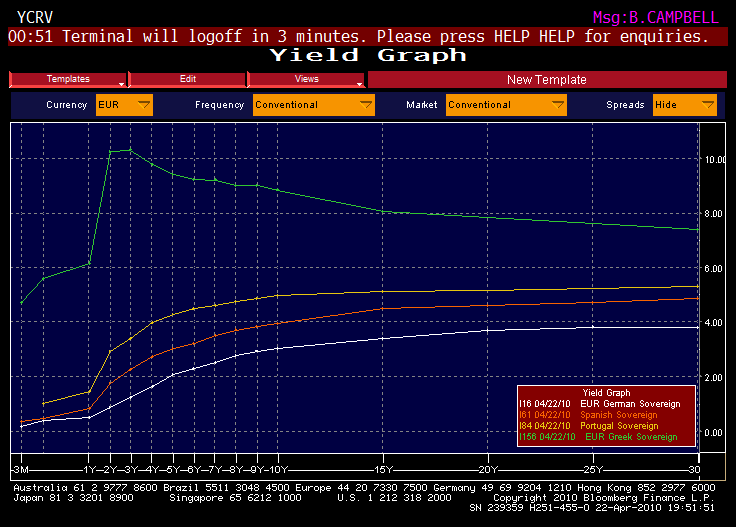
Spreads for Portugal, Spain and Greece are jumping up relative to a week ago. Except for Greece, the situation is not terrible, but there is growing evidence of the risk of contagion is very real as evidenced by the jump in Portugal and Spain's borrowing rates. The graphs are for today and last week, respectively.
Assumptions:
  • Greek GDP was approximately EUR 237B in 2009
  • Greek deficit was approximately EUR 32.3B, or 13.6% of GDP
  • Debt service costs based on at-issue yields of outstanding government bonds (Bloomberg: Crop GGB Corp) is EUR 11.7B
  • Therefore, the debt service is approximately 1/3 of the deficit.
  • Public sector spending accounts for 40% of GDP
  • Imports are in 2009 were EUR 47B and imports EUR 15.7B (source)
The haircut scenario:
  • What is this trying to accomplish?
    Reduce the debt burden on Greece so it can continue to operate.
     
  • After the haircuts will Greece start reducing net debt outstanding?
    No. Their structural deficit is twice the size of their debt service. Assuming a 50% haircut, Greece would still pay over EUR 5.8B a year in debt service, or 2.4% of GDP.
  • OK, So what's the point?
    The idea is to get Greece to the point where it's GDP is growing faster than it's total debt, reducing outstanding debt as a percentage of GDP. Without this, they would just be heading right back in the same direction.
Let's look at some of the problems with this plan. We commonly define GDP as:
GDP = Consumption + Investment + Government Spending + NetExports
  • Increasing government spending is out of the question. The government is already running a deficit which they are trying to reduce and the restricted access to capital markets makes going further into debt to stimulate the economy a non-starter. If anything, this number will be shrinking.
  • Furloughs, layoffs, wage cuts or benefit cuts would do nothing to increase consumption.
  • To increase NetExports you would need to reduce imports, increase exports or both. When a country devalues their currency, imports instantly become more expensive and exports more competitive, therefore instantly goosing this number. Greece, however, doesn't have this option because it is part of the Euro, so the answer is to reduce wages. Judging by the pictures of the protesters I've seen, I would expect significant resistance.
  • To increase Investment, businesses would have to start spending to increase in capacity. An increase in capacity spending would need to see increased aggregate demand.
Increasing retirement ages would decrease pension expenditures, but increase labor costs for government employees. With an already elevated unemployment rate (~9.8%), increasing the labor force does nothing except increase idle capacity. Because of the stickiness of wages in a highly-unionized labor force, the added capacity is unlikely to exert enough pressure to significantly reduce wages and increase utilization.
    As you can see, without the option of devaluation, stimulating GDP will not be easy. Without significant wage cuts or fiscal stimulus, the economy runs the very real risk of stalling and falling into a deeper recession. The Greeks have a real problem in their hands, and I see no straight-forward solutions. The more I look at the numbers, the more exiting the Euro seems like a good strategy.

    A Euro exit
    More than debt and associated debt-service, Greece's problem is it's financial obligations. They spend more than they collect and eliminating their debt is not going to change that. If the people refuse to accept cuts in nominal terms, they are going to have to accept cuts in real terms. Default is not going to magically fix this. If anything, the restricted access to capital markets would put even more pressure on the government to balance it's budget as borrowing to cover short-falls ceases being an option. If workers refuse to be flexible, inflating away obligations is the only choice if Greece wishes to get back to growth, and they can't do that without leaving the Euro unless the ECB debases the Euro, which is a topic for another post.

    UPDATE-1:  Peter Bookvar over at The Big Picture has this to say:
    There is talk that the package for Greece will total 120b euros over 3 years which would be much bigger than initially said a few weeks ago.
    EUR 120B is definitely enough money to delay default by 2, maybe 3 years. At 30B a year, it would be enough to cover all funding of the deficit, although there is that small matter of the 17B,still due this year, the 30B due next year and the 31B due in 2012 in combined short and long-term bonds coming due. (Bloomberg: GGB / GTB). The issue, once again, is that you'll just end up with a more highly-leveraged Greece. Without GDP growth or deficit reduction, this is just delaying the problem and making sure the fallout will be greater when it does hit.

    Friday, April 23, 2010

    A little more on Greece

    Last nigh,t I blogged about the inevitability of some kind of bailout and how liabilities don't just vanish, they just move to bigger balance sheets until they can't anymore and they need to be spread amongst a large number of individuals. Today, Peter and Simon over at the Baseline Scenario wrote the following:
    To restore confidence in buying Spanish and other major European nation bonds, it would surely help to have clear signals that President Obama himself, and the Federal Reserve, are taking an active stance now on making sure this does not spread to become another threat to global financial stability. A broader wall of preventive financing must now be put in place – after all, this is exactly why (in principle) the IMF was recapitalized this time last year.
    ATTENTION SAVERS OF PLANET EARTH: They are going to take your money. Whether it is through taxes, inflation, lost profits or non-performing assets. It sucks and I am completely against it, but, by definition, you can only take something from someone who has it, and you are the only ones with money.

    For those of you old people reading about this Greek debt crisis and thinking, "8% isn't that bad, my mortgage used to be 11% in the 80s, why should they get a cheap IMF loan?" Let me just put it this way: The additional yearly debt-service of refinancing the long term debt coming due in the next 8 months and 2011, assuming it is refinanced at a similar maturity, would be an additional 175MM EUR. So, as they are dealing with recession, strikes, and a giant budget gap in a deficit they need to shrink, their debt-service rises 175MM. They are fighting an uphill battle.

    For any of you econ geeks, if you haven't already, I suggest you read David Merkel's Of Credit Ratings, Sovereign Risk and Semi-Sovereign Risk as well as The Whole Earth is Owned; Debts Net Out to Zero. My writing could never compare.

    Thursday, April 22, 2010

    All debts must be paid, even Greek ones

    So, I'd like to publicly admit here that I was oh-so-wrong about Greece. It looks like they really won't be able to make it through May without a bailout. I really didn't expect this to happen until 2011 or 2012 but, with 10yr rates at over 800bp, fresh downgrades and rumors of restructuring, it doesn't look so good. While many are going to go on about the moral hazard in the bailout and why they should be kicked out of the Euro, I want to focus on something else.

    Why would other Euro countries agree to a bailout?
    Let's start with what I think is the biggest part, which I will explain with the this quote,
    "When you owe someone $1,000 and you can't pay, you have a problem. When you owe someone $100,000,000 and you can't pay, they have a problem."
    Banks across Europe hold Greek bonds. The fact that they could be repoed at the ECB for liquidity and they had a higher yield made them attractive. If Greek creditors push Greece too hard, they might just take their proverbial ball and go home. They really could just give up on the Euro and tell their creditors: I'm not paying you. If that happens, a lot of European banks are likely to face substantial losses. I can't tell you how much because there is no reliable source for this data, even what you see in Die Spiegel seems a little iffy. If what we saw during the Panic of '08 is any indication, banks taking the Greek losses would simply end up bailed out by their respective governments anyways. The liabilities won't vanish, they'll just move to a larger balance sheet until they reach the biggest one (governments), at which point they are socialized. It's just the way it works at this present point in time, so deal with it.

    Back to defaults: A ruthless external default would do no good for anyone. A disorderly financial meltdown would risk contagion across the rest of the heavily indebted EU nations and emerging markets. Rising spreads could put enough pressure on the likes of Spain, Italy or Portugal that they too decide they can't/don't want to play the EUR game anymore, which brings us back to the whole bank liabilities thing. Someone, somewhere owns all this debt and someone, somewhere is going to have to take a loss if we let this all get out of hand and, if that loss is big enough, then we'll all have to share this loss through inflation, recession, higher taxes, service cuts etc. There is no way around it, the debt must be paid in some form or another by someone. Stoking a disorderly collapse will just ensure we'll be the only ones cleaning up the ensuing mess.

    I love recession pr0n just as much as the next blogger (we are a bearish bunch) but these are real lives we are talking about. I am in no means fan of a bailout, but it might be the least-costly way to resolve this. Italy, Ireland, Spain and the UK are all on shaky ground as far as debts go, they don't need their spreads shooting up. A disorderly collapse that leads to bank bailouts, another recessionary dip and more fiscal stimulus sounds really expensive,  politically, socially and financially. Greece might be able to get out of this predicament, or not, but we won't know unless they get a chance. Yes, the proposed rescue package is essentially just kicking the can down the road, but time has a funny way of healing some wounds.

    I can't believe you are defending that profligate bunch! Why couldn't be more like industrious Germany with that awesome trade surplus?!
    Whatever, seriously. You can't run a surplus without someone running a deficit, it's just the way it works. Savers need borrowers and vice-versa. Not only that, but Greece paid a risk-premium. A risk-premium is extra yield you pay because there is--wait for it--risk! A risk-premium is what you pay for the right to fail. By asking for a risk premium the market is saying, "We'll lend you this money, but at higher rates because we are not sure you'll be able to pay us back." Creditors can demand their money all they want, but you can't take back something that isn't there anymore. They aren't going to get it, so they might as well try to be civil and try to figure out a plan to recoup whatever they can because at this point the debtor holds a lot of cards.

    To end, here's some graphs for your viewing pleasure (GREECE SHORT is short T-bills, the rest is bonds):

    Sunday, March 21, 2010

    More on the PIIGS Debt Coming Due

    Yesterday I wondered about whether all of this PIIGS debt panic was warranted. I don't contest that there is debt problems that need to be fixed (and not just in Southern Europe), but I also don't think that there's any reason to be alarmed over the debt coming due in the next couple of months. If you would, however, want to be alarmed by the debt coming due in 2012, I'd completely understand. The reason I'm not alarmed is because those euros have to go *somewhere* once these bonds start coming due and while there may be some movement away from Greece, it's not like liquidity is going to suddenly dry up for sovereign issues and Euro area countries are going to be stuck, unable to refinance their debt. Yeah, they might have to refinance it at higher yields, but they will refinance it. Considering how low interest rates are right now, I wouldn't be surprised if the debt they are retiring is going to be refinanced at lower rates, reducing the debt service expense. I'm working on this last point right now, but it's very labor intensive.

    Regardless of how many bad things you hear about these countries in the media, it's still sovereign debt, not corporate junk. It's not low-rated, you can repo it at the ECB and, most importantly, the other European banks are buying it. And you know what? As long as they can be repod for liquidity, the banks will keep buying these bonds and strolling carefree down the meadows of borrow short, lend long. Yields may or may not accurately reflect default risk, I do not know, but barring a huge, sudden jump in interest rates, this is just not that big of a deal. And since I don't see inflation in our near future, I'm not too concerned about that.

    In the mean time, a weaker Euro will probably help support tourism and give a boost to manufacturing, buying everyone a little more time.

    Saturday, March 20, 2010

    PIIGS Debt Coming Due: Is it really an issue?

    Der Spiegel published the following graph as part as the ongoing Portugal / Greece / Italy / Ireland / Spain crisis porn.


    Let's not all just freak out just yet. Let's do our homework:

    As of this writing the PIIGS are borrowing ta the following rates (Economist 3/20 -3/26):
    • Portugal: ??
    • Ireland: ??
    • Italy: 3m @ 64bp and 10y @ 390bp
    • Greece: 3m @64bp and 10y @594bp
    • Spain: 3m @ 66bp and 10y @ 384bp
    The economist also tells us that the average maturity of this debt stands as follows

    • Portugal: 6.5 years
    • Ireland: 6.8 years
    • Italy: 7.2 years
    • Greece: 7.7 years
    • Spain: 6.7 years
    Now, what I'd like to know is when this debt coming due was issued and at what cost to the government. If the yield at issue was higher than their current borrowing rates, well, that's not really a problem. Second, who owns all this debt? The local banks? foreign banks? regular people? If it's mostly local banks that hold this debt, i don't imagine the refinancing is going to be much of an issue, after all, the banks have to do something with that cash. Could rates move up as the supply of debt overwhelms the demand? Yes. Do I think this is as big of a deal as it is being painted to be? Hell no.