Showing posts with label too big to fail. Show all posts

Tuesday, May 4, 2010

This thing that looks like that thing: Greek bailout Edition (UPDATE-1)

A little over a week ago, Peter and Simon over at the Baseline Scenario wrote the following:
To restore confidence in buying Spanish and other major European nation bonds, it would surely help to have clear signals that President Obama himself, and the Federal Reserve, are taking an active stance now on making sure this does not spread to become another threat to global financial stability. A broader wall of preventive financing must now be put in place – after all, this is exactly why (in principle) the IMF was recapitalized this time last year.
Then Greece got a bailout of EUR 110MMM, but there was still trouble and John Mauldin wrote:
...30% of the Greek financing will come from the IMF ... and since 40% of the IMF is funded by US taxpayers, and that debt will be JUNIOR to current bond holders ... US tax payers will be giving money to Greece who will use a lot of it to roll over old bonds, letting European banks  and funds reduce their exposure to Greece while tax-payers all over the world who fund the IMF assume that risk. And does anyone really think that Greece will pay that debt back?
As if it wasn't enough that the ECB went back on their word and is allowing GGB to be repoed for liquidity regardless of the rating--this is the part where the ECB engineers a super-steep yield curve to transfer depositors money to bank balance sheets--now they are going to monetize the Euro debts.

I told you they were going to take your money. Let's file this one under, "this is not progress," shall we?

UPDATE-1: The WSJ reports that the US share of this is actually more like 17% and so we are only on the hook for $3MMM or so.

Thursday, April 22, 2010

All debts must be paid, even Greek ones

So, I'd like to publicly admit here that I was oh-so-wrong about Greece. It looks like they really won't be able to make it through May without a bailout. I really didn't expect this to happen until 2011 or 2012 but, with 10yr rates at over 800bp, fresh downgrades and rumors of restructuring, it doesn't look so good. While many are going to go on about the moral hazard in the bailout and why they should be kicked out of the Euro, I want to focus on something else.

Why would other Euro countries agree to a bailout?
Let's start with what I think is the biggest part, which I will explain with the this quote,
"When you owe someone $1,000 and you can't pay, you have a problem. When you owe someone $100,000,000 and you can't pay, they have a problem."
Banks across Europe hold Greek bonds. The fact that they could be repoed at the ECB for liquidity and they had a higher yield made them attractive. If Greek creditors push Greece too hard, they might just take their proverbial ball and go home. They really could just give up on the Euro and tell their creditors: I'm not paying you. If that happens, a lot of European banks are likely to face substantial losses. I can't tell you how much because there is no reliable source for this data, even what you see in Die Spiegel seems a little iffy. If what we saw during the Panic of '08 is any indication, banks taking the Greek losses would simply end up bailed out by their respective governments anyways. The liabilities won't vanish, they'll just move to a larger balance sheet until they reach the biggest one (governments), at which point they are socialized. It's just the way it works at this present point in time, so deal with it.

Back to defaults: A ruthless external default would do no good for anyone. A disorderly financial meltdown would risk contagion across the rest of the heavily indebted EU nations and emerging markets. Rising spreads could put enough pressure on the likes of Spain, Italy or Portugal that they too decide they can't/don't want to play the EUR game anymore, which brings us back to the whole bank liabilities thing. Someone, somewhere owns all this debt and someone, somewhere is going to have to take a loss if we let this all get out of hand and, if that loss is big enough, then we'll all have to share this loss through inflation, recession, higher taxes, service cuts etc. There is no way around it, the debt must be paid in some form or another by someone. Stoking a disorderly collapse will just ensure we'll be the only ones cleaning up the ensuing mess.

I love recession pr0n just as much as the next blogger (we are a bearish bunch) but these are real lives we are talking about. I am in no means fan of a bailout, but it might be the least-costly way to resolve this. Italy, Ireland, Spain and the UK are all on shaky ground as far as debts go, they don't need their spreads shooting up. A disorderly collapse that leads to bank bailouts, another recessionary dip and more fiscal stimulus sounds really expensive,  politically, socially and financially. Greece might be able to get out of this predicament, or not, but we won't know unless they get a chance. Yes, the proposed rescue package is essentially just kicking the can down the road, but time has a funny way of healing some wounds.

I can't believe you are defending that profligate bunch! Why couldn't be more like industrious Germany with that awesome trade surplus?!
Whatever, seriously. You can't run a surplus without someone running a deficit, it's just the way it works. Savers need borrowers and vice-versa. Not only that, but Greece paid a risk-premium. A risk-premium is extra yield you pay because there is--wait for it--risk! A risk-premium is what you pay for the right to fail. By asking for a risk premium the market is saying, "We'll lend you this money, but at higher rates because we are not sure you'll be able to pay us back." Creditors can demand their money all they want, but you can't take back something that isn't there anymore. They aren't going to get it, so they might as well try to be civil and try to figure out a plan to recoup whatever they can because at this point the debtor holds a lot of cards.

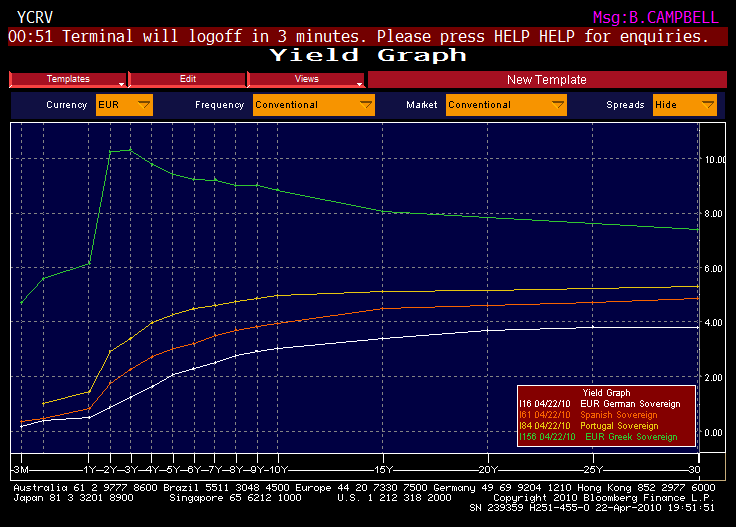
To end, here's some graphs for your viewing pleasure (GREECE SHORT is short T-bills, the rest is bonds):

Sunday, March 21, 2010

More on the PIIGS Debt Coming Due

Yesterday I wondered about whether all of this PIIGS debt panic was warranted. I don't contest that there is debt problems that need to be fixed (and not just in Southern Europe), but I also don't think that there's any reason to be alarmed over the debt coming due in the next couple of months. If you would, however, want to be alarmed by the debt coming due in 2012, I'd completely understand. The reason I'm not alarmed is because those euros have to go *somewhere* once these bonds start coming due and while there may be some movement away from Greece, it's not like liquidity is going to suddenly dry up for sovereign issues and Euro area countries are going to be stuck, unable to refinance their debt. Yeah, they might have to refinance it at higher yields, but they will refinance it. Considering how low interest rates are right now, I wouldn't be surprised if the debt they are retiring is going to be refinanced at lower rates, reducing the debt service expense. I'm working on this last point right now, but it's very labor intensive.

Regardless of how many bad things you hear about these countries in the media, it's still sovereign debt, not corporate junk. It's not low-rated, you can repo it at the ECB and, most importantly, the other European banks are buying it. And you know what? As long as they can be repod for liquidity, the banks will keep buying these bonds and strolling carefree down the meadows of borrow short, lend long. Yields may or may not accurately reflect default risk, I do not know, but barring a huge, sudden jump in interest rates, this is just not that big of a deal. And since I don't see inflation in our near future, I'm not too concerned about that.

In the mean time, a weaker Euro will probably help support tourism and give a boost to manufacturing, buying everyone a little more time.

Sunday, January 31, 2010

This is not progress: Move Your Politician’s Money?

 From The Baseline Scenario:

what happens when the location of political candidates'own money starts to matter. As early as this fall's primaries, expect to hear people ask politicians in debates and through various kinds of interactions: (1) where do you, personally, keep and borrow money, and (2), in all relevant cases, where did you put public money when it was up to you?

Make them put the money where their mouth is? Seems plausible for demand deposits, notes and revolvers; however, who you gonna call when you need to place $3B of callable notes in the muni mkt? Hopefully not your friendly neighborhood credit union. Investment Banking: somebody gotta do it.

Don't government agencies have to use the service provider of least-cost that meets all of the stated deliverables? What happens when Mayor Joe Corrupto decides to do all the town banking through the local Bank that his biggest campaign donor is heading?

Don't get me wrong, I think the idea makes a tiny bit of sense. But only if local banks can provide the same or better service for equal or lesser cost than TBTF banks. Any other way is just begging for favoritism and corruption.